
Walking with Survivors of Violence in Kenya
The following article was written by journalist Vicky Arias and published in 2026. It explores the challenges survivors of violence face in Kenya and highlights the work of Justice Pamoja and its partners in expanding access to legal assistance.
The views and reporting are those of the author.
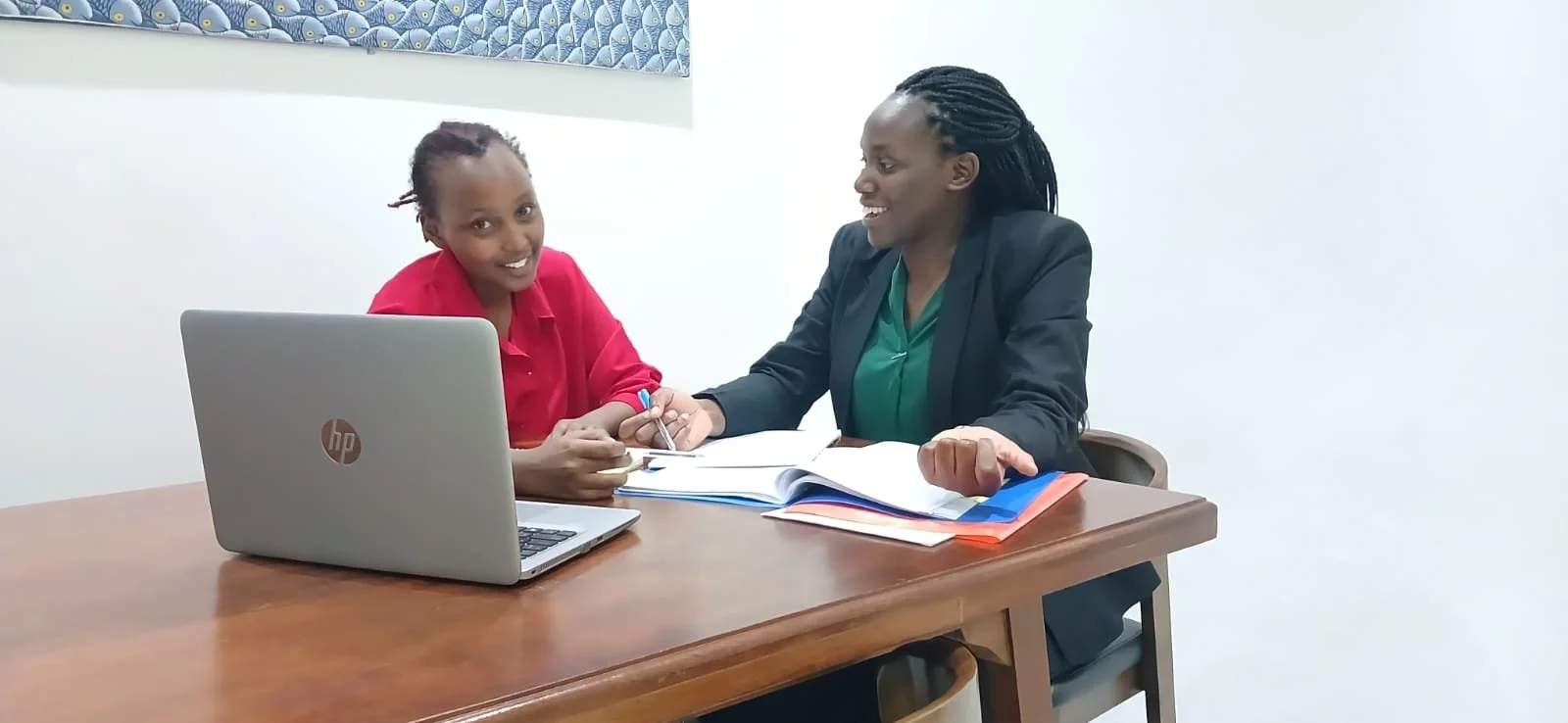
Justice Pamoja Senior Advocate Loise Ng’ang’a (on the right) debriefs with a law student following their day in court.
An epidemic of violence is occurring within vulnerable populations living in Nairobi, Kenya. Nearly half of the citizens of the city, or approximately two to three million people, live in informal settlements fraught with crime, poverty, and extreme difficulties in obtaining justice. In these settlements, justice through formal courts and policing is often compromised, scarce, or logistically complex to reach.
Local leaders have been known to discourage survivors of violence, typically women and children, from involving police, citing that it will upset the peace of the community. And for those not living in the settlements, justice can remain out of reach due to mishandling and corruption. These failures within the justice system have contributed to a culture where violence has become normalized within much of Kenyan society.
According to a 2025 report from Reuters, “gender-based violence has long been a major problem in Kenya because of patriarchal views, socioeconomic inequalities and insufficient legal protections, researchers say.” The report added that “Kenyan law does not criminalize spousal rape, meaning it can only be punished under laws covering non-sexual assaults.”
Additionally, UNESCO stated in Oct. 2025 that “40% of women in Kenya have experienced emotional, physical, or psychological intimate partner violence, 30% of women, and 19% of men believe a husband is justified in beating his wife under certain circumstances, and 34% of women aged 15–49 have experienced physical violence.” The report analyzed that “these figures reflect deeply entrenched socio-cultural norms that normalize violence and silence victims.”
Loise Ng'ang'a is a practicing attorney and Advocate of the High Court of Kenya. She works with Justice Pamoja (JP), a non-profit organization which provides free legal help for survivors of violence in Kenya, in the capacity of a Senior Advocate. She explained to me that she “represent[s] survivors of violence, not only to pursue justice for them, but to ensure that they are safe and can lead normal lives.”
Ng’ang’a stated that survivors are not always treated with respect, and are, at times, even paid to keep their silence.
In certain parts of Kenya, “the survivor of rape is married off to the rapist or the family if hushed up with money or cattle as a form of compensation,” Ng’ang’a stated. She continued, saying that, despite attempted reforms by the Kenyan government, “the impact is not [being] felt on the ground where normal Kenyans are [affected].”
Ng’ang’a became interested in representing survivors as violence against women in Kenya became more prominent. The rampant abuse prompted anti-femicide marches in January and December of 2024 in Kenya. Femicide is the intentional murder of a woman or girl purely based off their gender.
Ng’ang’a stated to me that “survivors of violence [in Kenya] are prevented from getting justice because they lack support from their families, face stigmatization, and financially cannot support themselves and the institutional and procedural failures in the country.”
Nancy,* a survivor living in Kenya, endured terrible physical violence from her partner. She tried to tolerate his abuse because of her two children, however, as the violence worsened, Nancy knew that if she stayed, she risked losing her life.
It all began when Nancy was 24 years old. She met a man, fell in love, and things were good, until her partner became violent.
During my interview with her, she stated that the first incident of abuse came when she was 25. She explained that she arrived home late one evening from work but was met with violence when her partner didn’t believe her explanation of where she had been.
He flew into a jealous rage and beat her. The next day, the man was very apologetic and cleaned and cooked for her. He was so convincing and appeared to be deeply sorry, which made Nancy believe the violence would be a one-time occurrence. Unfortunately, that turned out to be far from true. Nancy’s partner continued to physically abuse her, even blaming her for having a miscarriage and beating her for it.
The abuse continued for three very difficult years, until one day, Nancy’s partner snapped again. His anger spiraled so badly that he attempted to take her life. At this point, she was 28 years old, and caring for her two young children, who were two years old and six years old.
She explained to me that her partner beat and choked her, and when she tried to run away, he threw boiling hot oil on her. Nancy sustained burns to her face and the left side of her body, which left her with scars.
After the incident, she made the brave decision to take her children and flee from her partner. It’s been ten years since she left, and she has since made a new life for herself and her family. She went back to school and received a nursing degree in November 2025 and has enjoyed her freedom since breaking away from the abuse.
Nancy explained that after being burned, she felt very isolated and didn’t have anyone to talk to about her trauma.
When she heard about the work being done through Justice Pamoja, she traveled two hours to speak with someone and discuss her case. Advocates there explained that she has a legal right to financial support from her ex-partner. However, the grim reality is that, given the current Kenyan justice system, actually obtaining it will be difficult and her safety cannot be guaranteed.
Nancy made the choice to wait to pursue the case, with the knowledge that JP advocates remain willing to provide free legal assistance to her should she ever change her mind. In the meantime, she has decided to become involved in helping other survivors by sharing her story with the hope that they can draw strength from knowing they are not alone. She has also decided to learn more about her rights through free seminars offered through JP.
Nancy stated that, “speaking will help as a process of healing.”
Justice Pamoja was started by Brian Cooper, who, in light of the widespread violence in Kenya, decided to roll up his sleeves and assist survivors. Drawing on his years of legal expertise and a heart to help others, he founded the organization last year. As stated above, it is a legal aid organization dedicated to providing free legal counsel to survivors of violence. The organization partners with local clinics to offer legal advice and representation to survivors. They also provide training for law students who oversee survivors’ cases with the assistance of practicing attorneys. According to Cooper, “serving individual survivors who would otherwise have no recourse is the immediate goal.” And his long-term hope is that the model of his organization would pull the local Kenyan community together to help one another and provide aid that is sustainable for generations to come.
Establishing an organization such as this has been a years-long dream for Cooper. His desire is “to work on human rights issues in a very direct and tangible way, and to do so as an expression of a shared Christian faith.” He adheres closely to Matthew 6:6, which teaches Christians to help others as a means of glorifying God and not for public reward.
“But you, when you pray, go into your room, and when you have shut your door, pray to your Father who is in the secret place; and your Father who sees in secret will reward you openly.” Matthew 6:6
When reflecting on Nancy’s case, Cooper expressed gratefulness to have played a part in her story and stated that it had a significant impact on him.
“[Justice Pamoja] gave [Nancy] the opportunity to share her story with those who are experiencing violence today, sharing with them the success and happiness she has enjoyed since getting away from her abusive husband,” Cooper stated. “When we had our second clinic, Nancy wanted to participate. She knows that Justice Pamoja is ready to support her if the day comes when she does want to pursue her rights through the justice system…And I’m honored that Justice Pamoja has a small part in giving her that opportunity.”
*Name changed to protect the privacy of the individual.